Airline Innovation Talk with Alberto Terol Conthe, Head of Customer Experience Design and Development at Iberia

( This is a transcript of the podcast from Diggintravel, by Iztok Franko https://diggintravel.com/airline-innovation-talks-iberia/ )

«What does windsurfing have to do with Marketing and Innovation?»

My friend Iztok Franko started his last podcast with quite an eclectic and inspiring question.

I had a great experience talking to him about my vision as a #Marketing#Strategy and #Innovation proffesional.

If you want to listen to it, here is the link: https://lnkd.in/guENe96M

Some frameworks that we were discussing were:

* Effectiveness / Efficiency
* Real / Win / Worth
* Design the right things / Design things right
* Value creation / Value delivery
* Experimentation / Exploitation

Thanks a lot, Iztok, for challenging me with such though provoking questions

*******************************
“Iztok, I love your new podcast series. You had an airline digital talk. Then you did an airline data talk. What’s next?”

This is what somebody asked me recently on LinkedIn. For me, the next step was obvious: next in line was an airline innovation talk.

Why an airline innovation talk? Because recently when I was thinking about innovative solutions, I started to think, where does innovation really happen? Can you point a finger at one department, one area in a company? Are innovation departments the solution?

In my opinion, innovation happens when you combine insights from different areas and different people: data and analytics, digital experience, UX/UI, experimentation, customer research, customer service, product design, etc. To do innovative things, one needs to know all these areas and understand how they fit together. You need to know how to leverage insights from these areas to understand your customer’s pain points and build innovative solutions to address those needs. And this is what marketing should be all about: how to provide value for your customers.

As I was thinking about all these things, I remembered a great post about marketing and innovation I read a while ago. The article was titled “Marketing Hero“, and it was written by Alberto Terol Conthe. So, the guest for our airline innovation talk was a no-brainer.

Airline Innovation Talk with Alberto Terol Conthe, Head of Customer Experience Design and Development at Iberia

Marketing (Value) + Innovation (Creation)  = Value Creation

Alberto opened his article with one of my favorite quotes by Peter Drucker: “Business has only two basic functions, marketing and innovation.” So, my first question for him was, how do marketing and innovation fit together?

I always have thought that they are all together. I’m a marketeer. I started as a marketeer at 3M. Previously I was working in Accenture consultancy as well. But I would say my main business school was marketing, and then moving into innovation, I think they are very close fields. I tend to think marketing is about value, is about understanding customer needs. It is part of the discovery, the research, and understanding the pains and gains of the customer, and innovation is more about creation – bringing some new ways of doing things and new processes and new technologies.

If you put them all together – value creation, marketing, and innovation – they go so well together. It’s turning an idea based on some customer pain or gain into a solution and executing it and providing value from the customer perspective. So they go together. And I think the skills of good marketeers and good innovative people are quite similar. They are around curiosity, questioning everything, bringing the what and the how and the when and the why to every conversation.

Alberto mentioned that execution is an important element of marketing. Recognizing your customer pain points and figuring out innovative solutions is not enough.

I think a fundamental element, as well, of marketing and innovation is the execution. I have had a lot of discussions with certain designers and people from innovation like, “We created this beautiful PPT, and now it’s a matter of the execution team to execute.” My point is that unless a product or a service is crafted and then deployed into the market and it’s being consumed by a customer, there is no success at all. It’s just an idea.

In Successful Companies, Innovation Sits Very Close to the Business

The way Alberto talked about marketing and innovation made a lot of sense to me. But what I see in most companies, especially the big ones, is that marketing is still mostly about advertising – or, in the digital marketing case, it’s mostly about taking care of the website, ecommerce, and digital advertising. Why do we often see a separate innovation department?

I think marketing is very wide. My background is product marketing. You mentioned all the branding and channel management and stuff, and that’s part of marketing. But maybe what I would compare more between marketing and innovation is product management. There, I think it’s very close to each other.

Another example I would bring to you is that I think innovation teams in large companies sometimes are located in the HR people area because of all the change management needed and all the transformation efforts and so on. I think sometimes, very frequently – and I think nowadays even more frequently – they belong to the IT and technical organization, because it’s very much leveraging technology.

Alberto has recognized a pattern when it comes to innovative companies:

The examples I have seen as more successful normally are those in which these companies put the innovation function – the initial innovation function, because I think it has to embrace the whole organization – but let’s say the team mobilizing innovation from the very beginning sits very close to the business. Therefore, again, I see the link between marketing – which for me is value creation and value delivery, which is basically business – very much related to innovation.

Doing The Right Things Vs. Doing Things Right

One other part of Alberto’s article that I really liked was the distinction between two key areas of marketing. One is execution; Alberto calls it “doing things right.” The other part is more about forward-thinking, strategic foresight, and business modeling, and that’s what he calls “doing the right things.”

That’s a sentence [distinction] that we use very much in our service design team. I think both steps are needed. It reminds me a little bit of the Double Diamond in service design, the divergence and then the convergence. I think these two elements – designing the right thing, for me it belongs more to marketing. It’s discovering the underlying customer need, the pain, the job to be done, and so on. It’s designing the right thing.
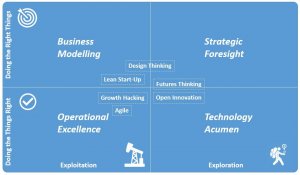
Airline innovation and marketing framework

Source: Alberto Terol Conthe (LinkedIn)

When it comes to figuring out what the right thing is, Alberto mentioned an interesting “Real, Win, Worth” framework.

In 3M we had a heuristic that we used very frequently in designing the right thing, which is Real, Win, Worth. Every time we wanted to address if an opportunity was worth it for 3M, we would first envision if it was real, if there was a market, if there was a customer pain or need to be addressed. Is this opportunity real? The second one was, can we win? Do we have the capabilities in our company to achieve a successful business out of this opportunity? And the third one would be worth. Is it worth it, or would it be so costly or I would have to hire talent that I don’t have? Okay, so there’s opportunity, we could potentially win it, but it’s not worth it. Or it would not support our strategy or whatever. So for me, that’s the designing the right thing – deciding what you’re going to design and what’s out of scope as well, which is also very important.

And then we moved into designing things right. There is more the world of service design, designing a product and service that matches those needs that you have discovered in the designing the right thing. It has much more to do with UX, UI, choosing the right platform for delivering that product or service, choosing the right partners. It’s more the delivery part of the value. You can be very strong in value creation, but you can be very poor in value delivery. Again, execution becomes fundamental in the second part. We always, as service designers, try to keep both areas balanced – designing the right things, choosing the right fights to fight, but then deciding something that was worth it for the customer and appealing.

Top-Down or Bottom-Up?

To me, this concept of doing the right things and doing things right was really interesting. My background, my experience, and also our Diggintravel Airline Digital Optimization research is more about doing things right – how to be agile, how to do growth marketing, how to do digital optimization and conversion optimization. But if you do systematic digital optimization right, with agile loops of analyzing customer needs, managing data, doing structured analytics, trying to find solutions and designing digital products to address those needs, you’re basically moving up to doing the right thing. So, I asked Alberto: how are these things connected?

It’s iterative. You could eventually start defining an arena that you want to fight for. That’s the design the right thing. Then you move into design things right, and then you discover that it’s impossible to deliver value in that field. Then you may decide to reassess if you are fighting for the right opportunity, or you could move into an adjacent opportunity or so on.

I think it’s an iterative process, and moreover, I think when you launch a product – and this is something we very often forget as service designers; we forget about the product when it’s being delivered. I think especially in those first weeks and months and even years after the launch, they should be in hyper-care, and we should be reconsidering every time, every week, following the KPIs, the metrics, and improving the product.

Alberto recognizes the value of applying the principles of experimentation and being agile to the overall business model and overall products, not just the digital side.

I had once a boss that always came with the question, “Are you 100% sure that this product will be successful?” I said, “Come on, I’m not, but this is the Pareto principle. I’m pretty sure that’s the case. I would say I’m 80% confident that it’s the right product for the right market segment. But let’s launch and let’s learn on the go and adjust and adapt.” So I’m very fond of experimentation and agile launching of new products. Otherwise, it’s paralysis by analysis.

Finding new solutions versus optimizing existing ones

A systematic loop of digital optimization is great for incremental improvement, but you have to know whether you’re optimizing the right things.

I think the other element – because you start with A/B testing and improving and these incremental improvements – the reason I was mentioning that designing the right thing is so important is because very often, especially these days, there’s obsession with efficiency. “We have to deliver efficiency gains.” My point is that there’s nothing so useless as doing something very efficiently which is not usable at all, or that we shouldn’t have done at all. We can be executing something beautifully, it’s very efficient, but there is no customer need or there is no market to be addressed. I think therefore we need to keep balance on both aspects.

But experimentation, rapid prototyping and so on – in fact, we had a discussion earlier this week about prototyping. We were discussing research and we want customer research in which we would envision what customers want for a specific product segment. My point was that customers would never come with a solution. That’s the job of the product owner, of the marketeer. Eventually, by prototyping and showing them some mockups, we can show them, “This is the size and the color and the shape that this would have. Are we working in the right direction, or is this something that doesn’t resonate with you at all?” I think all this rapid experimentation makes perfect sense with any product launch.
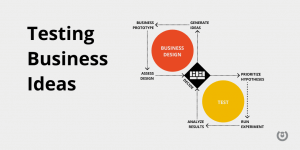
Connection between design thinking and experimentation

Source: Visual Summary of “Testing Business Ideas” by David J Bland and Alex Osterwalder

Innovation Is More About Attitude and Culture Than It Is About Skills

One of the key insights Alberto shared in our airline innovation talk was in regard to his key learnings. The first thing he mentioned was attitude:

I thought that innovation was more about skills. I think over the years, I’m discovering that it’s far more about attitude. That’s the approach when I’ve been hiring marketeers in 3M, or now service designers at Iberia: bringing people with curiosity, with this sense of observation, with customer obsession – and when I say customer obsession, it’s spending a lot of hours with customers, interacting with them. Not focus groups, which is a controlled environment, but observing customers dealing with our products and services.

Then Alberto mentioned another interesting aspect of innovation and culture.

I would say another totally different topic which is relevant for progressing with innovation in companies is how managers get measured. Maybe in the vision statement in a company, it says that “we would like to be the most innovative.” Okay, let’s go into the KPIs that managers are using. Are they being measured by the business as usual or by exploring the next big thing? Very often, that tells you the culture of innovation which is happening in the company.

I mentioned culture. For example, something I loved about the American approach to innovation – and I experienced that in 3M, but I’ve been talking with friends from HP, Salesforce – I think in American corporations, there’s emotional safety within the teams for putting some time for exploring and trying to discover things out of business as usual. The famous rule of the 15%. There are many different mechanisms for making the teams work on something which is enriching the total knowledge within the company, and they can openly share their findings, and mistakes are allowed and so on. That cultural aspect is fundamental as well.


Olvídate de enviar una newsletter

Las newsletter son para el email marketing, lo mismo que el volante en los coches. Se trata de un elemento principal, que cualquier organización con una estrategia de marketing digital, y algunas pocas herramientas tenía en marcha para informar a sus clientes de diferentes novedades. Sin embargo, debemos plantearnos su utilidad actual.

Existen varias discusiones en este mundo, que debemos juntar para poder tener una visión más amplia y poder responder a todas estas dudas que surgen.

Por un lado está la pregunta de la efectividad del email marketing. En este mismo blog hemos hablado varias veces de este tema (link). Aunque, mas allá de nuestra opinión, siempre hay que contrastarlo con datos. Existen multitud de estudios y cifras publicadas al respecto. en la web de una de las empresas que se dedica a publicar benchmarks y estadísticas, podemos encontrar este Link. Simplemente con una ojeada podemos ver que las cifras del email marketing en general pueden ser mucho mas rentables que otros canales (comparando coste, con beneficio e impacto). Podríamos discutir largo y tendido, pero creo que con estas cifras en las mano, podemos decir claramente que el email no esta muerto ni muchísimo menos. Habra segmentos de la población, o ciertas situaciones que requerirán de la conexión mediante el uso de otros canales, pero el email es un canal que funciona, y que tiene mucho que decir todavía.

La segunda pregunta, es más genérica, y más importante incluso. El impacto, o el famoso engagement. ¿Cómo podemos generar el máximo engagement con nuestros clientes?. No hay equipo de marketing que no se haga esta pregunta de forma diaria (y sino es así, algo está fallando). Uniéndolo a la pregunta anterior tenemos la pregunta de, ¿Conseguiremos un buen engagement mediante el email? La respuesta está en las cifras antes mencionadas. Pero esas cifras son genéricas, tendremos que estudiarlo con las nuestras propias (lo que nos lleva a pensar si tenemos herramientas para sacar y visualizar esta información, y si podemos unir estas actividades a nuestra visión corporativa). Posiblemente no estemos haciéndolo mal, pero es necesario una revisión constante del contenido que enviamos.

La newsletters nacieron como herramientas para comunicar novedades y noticias de actualidad de nuestra organización con diferentes actores (clientes, prospectos,..). En esas comunicación se encontraba, por lo general, información genérica y de alto nivel, de forma que pudiera ser útil para todos los componentes de esa audiencia. Como sabemos, y hemos oido innumerables veces, la personalización es vital. Personalización en todos los sentidos, subject, contenido, etiquetas,.. Posiblemente la pregunta que te surja será, ¿Y como hago esto con una newsletter si es algo más bien genérico?. Efectivamente, aquí es donde surja la necesidad de evaluar la necesidad de seguir enviando newsletters. En muchos casos, he visto que las organizaciones tienen problemas para decidir qué contenido añadir a su newsletter (la dificultad de la creación de contenido, suele ser algo común a casi todas). Es decir, nos ¨complicamos las vida¨ para poder enviar estos emails, cuando su impacto está siendo mucho menos que otras comunicaciones que enviamos. Los contactos de nuestras comunicaciones están buscando contenido personalizado, y muchas de los otros emails que constituyen los diferentes journeys son mucho mejor recibidos.

El primer paso sería identificar cual es el objetivo que buscamos como organización con el envío de estas comunicaciones. En muchos casos, estas newsletter seguro que pueden ser eliminadas, ya que la información buscada por nuestros contactos la tienen disponible (web, otros emails, redes sociales,..). En otros casos, posiblemente lo que tengamos que hacer es pensar en una estrategia de hiper-personalización de la newsletter, cuyo contenido sea dinámico, en función de las preferencias de nuestros contactos. Es decir, que la newsletter que yo reciba, no tenga la misma información que la tuya. Esto es posible con las plataformas de email marketing existentes, pero requiere tener los datos necesarios de nuestros contactos para poder ejecutar esta estrategia.

La newsletter, al igual que cualquier otra comunicación, tiene que ser examinada bajo lupa de forma constante. Hay que analizar el impacto y efectividad. La innovación es este caso vendrá determinada por nuestra capacidad para poder entender las necesidades de comunicación de nuestros contactos y ajustar las de nuestra organización de forma que ambas converjan en la misma dirección. La revisión del customer journey será algo en constante análisis.

¿Tenemos que eliminar las newsletter de nuestras comunicaciones? Todo depende de qué busques, como comuniques, del nivel de personalización (y madurez digital) y cómo podamos y queremos fusionar esta con otras comunicaciones. Como deberes, repasa el impacto que tiene ahora, y el que pueda llegar a tener.

How flying drones will boost your curious mind

“A desk is a dangerous place from which to view the world”

John Le Carre

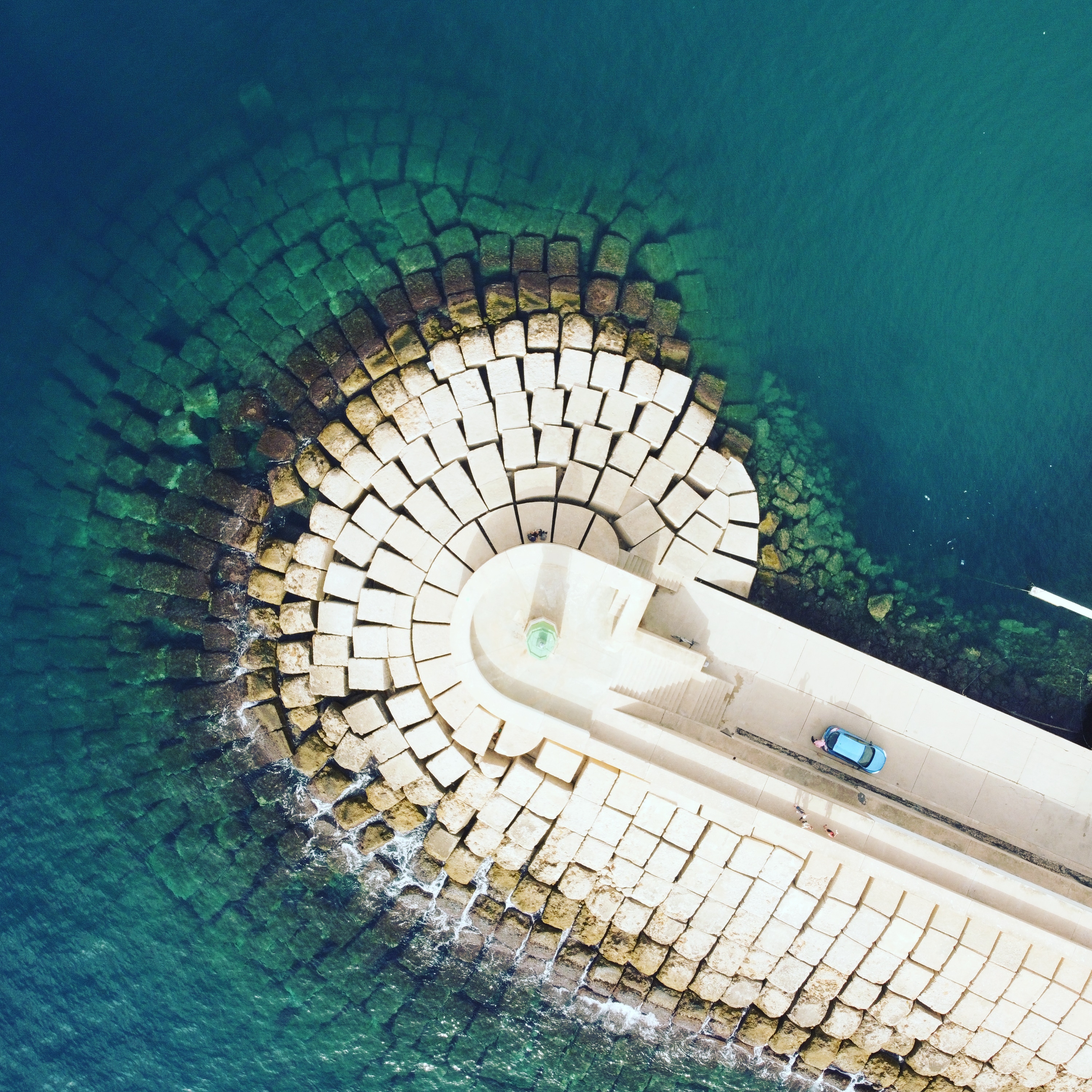
I was waking up every day at 6:00 am during my holidays. It was just the right time to ride my bike to some beautiful small beaches in the cozy coast of Alicante and experience a stunning sunrise. I was completely alone, and I could fly my drone to capture some beautiful vertical shots of the coast line, where blue and orange merge with each other.

I could not explain the reason behind my proactive daily exercise of “sleep deprivation”. Why I would sacrifice resting in the bed for such a physically exhausting experience?

While talking about it with a great mentor and friend, he answered to me straight forward: “you do it because that is your nature, you always love to see the world from a different angle and then spread the word about what you have observed”.

Ups, I never thought about my passion for aerial photography in such way, but moreover, I had never reflected before on that to be the reason and the fundamental link between the main areas of expertise during my professional career: Marketing, Strategic Planning, Innovation, and Customer Experience.

But my mentor had no doubt: that was the backbone of what I have been doing along the years: observing, empathizing, modelling and taking action. And everything started with a sense for deep observation, whether it was analyzing a market, a technology, a customer or a competitor.

Isn’t it that what Marketing, Innovation and Customer Experience is all about?

September – Personal goal setting time

Summer is normally the best moment for personal deep-thinking. I don’t believe leveraging on January as a kick-off opportunity for making commitments make sense for me, as September seems to be a more natural period for it.

While internal personal goals definition is great, I was thinking about making a public commitment this time. Just as Hernán Cortés did by destroying the ships when arriving in America so chances of coming back were reduced, making public commitments acts as a powerful nudge to act on them.

I found the metaphor of “drone flying” for sound observation of the world around so powerful, that I’m making it my personal motto for the 2021/2022 season:

During 2021/2022 season, I will be “flying drones” to observe the world from a radical different angle

And that “flying drones” approach will mean everything that:

  • Helps acquiring new knowledge and represents a significant upskilling opportunity.
  • Supports meeting new people and discuss about Innovation and Product Management from a totally different perspective.
  • Broadens the view of the world and the relevant social and economical changes that are happening these days and those to come.

So there we go, these are some of my 2021/2022 goals… 😉

  • Skilling – Become a certified drone pilot

First things first. Beyond the metaphor, real drone flying is amazing. While I have made a good progress this year and I got my official AESA pilot ID, I want to progress by getting the license to fly bigger beasts above 250gr. That would permit accessing new territories and keep on observing the world up to 120 meters.

  • Boosting creativity – Learn a new instrument

Being a father, I’m amazed with the curiosity that kids have with everything. The beauty of learning something new from zero is just phenomenal. Last year I tried to play piano for the very first time during the lockdown. While becoming a new Mozart is far away from my aspirations, just being able to play some easy pop songs would be great. Observing the notes, understanding how they interact among each other as chords, and creating some music out of it produces so much pleasure.

  • Upgrading my professional toolkit – Embrace “no code”

Although I personally do not physically create digital products, I’m responsible for the conceptualization, launch and operation of many of them. Proven that I don’t have a coding background and I’m not a developer, embracing the possibilities that “no code” brings will very much help conceptualizing and prototyping new digital services without costly and time-consuming processes. There are a couple of interesting programs to get to know “non-code” that I’m exploring right now.

  • Establishing new connections – Meet relevant people from other industries

What you eat has a fundamental effect on how you feel. The same applies to feeding you brain by meeting relevant people and have sound conversations. The quality of your perception of the world is highly correlated with the quality of the conversations you have with bright and optimistic people around. It is my intention to have at least 1-2 powerful conversations a week and so far, I’m being quite successful.

So here is the plan. After making this public commitment, I will be summarizing the progress done by September 2022. For sure these plans will get somehow derailed, but that will be OK as the other projects colliding with this initial plan help me progressing with the ultimate goal: getting better at observing, empathizing, modelling and taking action.

Let me know should you like to fly together…

There is no way to fix a broken mirror

“The increase of disorder or entropy is what distinguishes the past from the future, giving a direction to time.”

— Stephen Hawking, A Brief History of Time

I can see it happening every day. People waiting and expecting that sooner than later the pre-Covid situation will come back. They talk about “the new normality”, “coming back to the office”, “coming back to the old good days”,…

I have important news from them: that won’t be the case. Period.

And it won’t be the case for a very powerful reason. It is not my very personal view or a subjective criterion.

The reason why the past situation won’t be back is just that it would be against the laws of Nature, against the fundamental principles of Physics, against what has happened every time a deep disruptive event has introduced chaos in a complex system.

If a mirror is broken, it is absolutely impossible to recover it to the previous status. You can glue it or use it for making a beautiful ornamental device, but it won’t be the same mirror anymore.

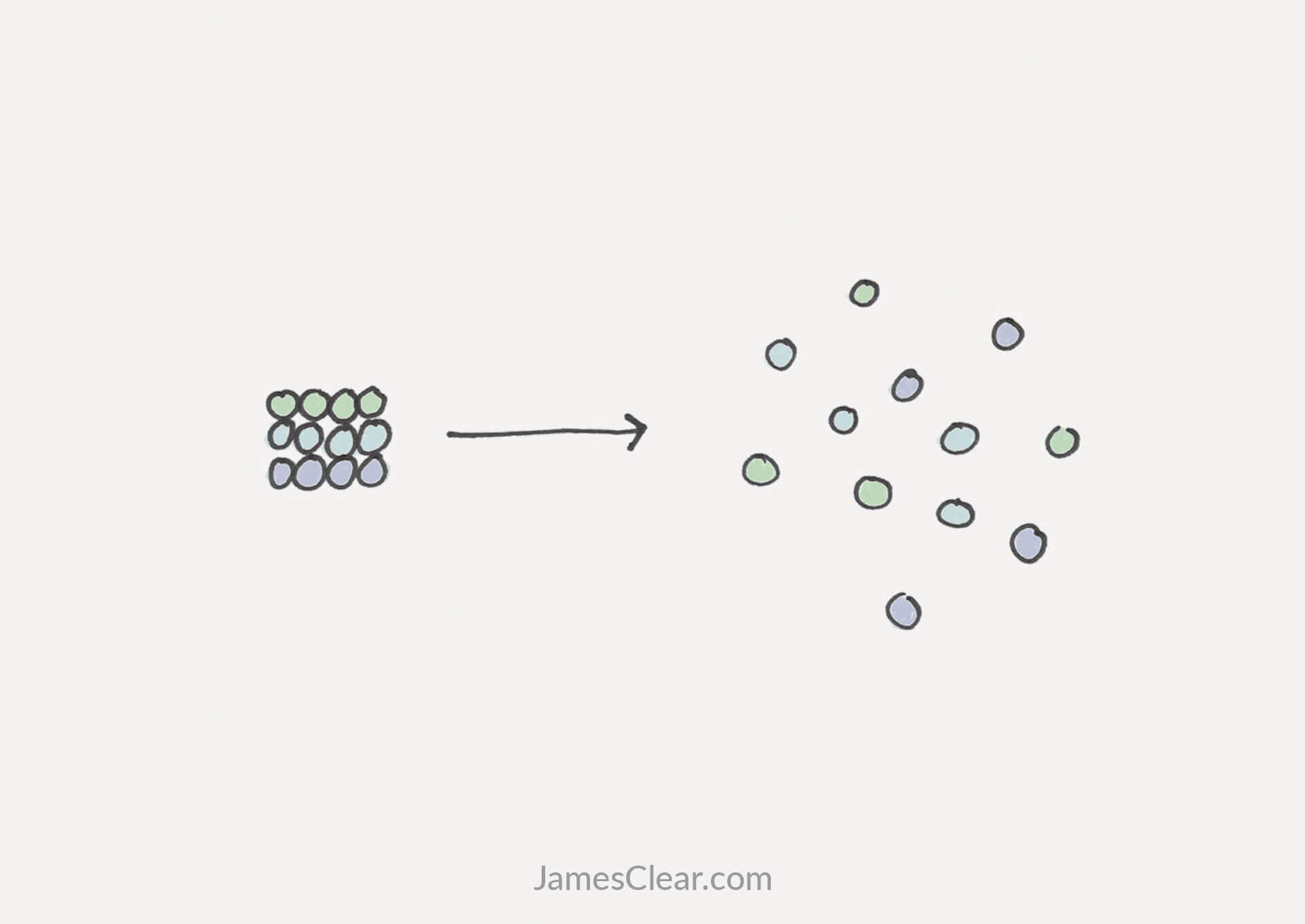
It is the Entropy, my friend

The law of entropy increase was first born out of thermodynamics and was discovered when studying the efficiency of perpetual motion machines and heat engines.

The second law of thermodynamics states that “as one goes forward in time, the net entropy (degree of disorder) of any isolated or closed system will always increase (or at least stay the same).

Well, but in the business world, Physics don’t apply…

You think so? OK, just please tell me any mayor industry disruption that ended into a situation close to the original one (same market dynamics, same competitors, same customer behavior,…). I bet you won’t come with any example, because that simply does not happen.

Physics do apply to every process in the world, and business is not any different. In fact, I believe a key element of business success has very much to do with how team leaders manage energy

OK, so as the future will be a disaster, I just give up

No way!!!. I haven’t said the future will be terrible, I just said that it will be different, by definition. So, the sooner we all stop moaning and focus on observing how this complex system is evolving and how to capture the bright opportunities to come, the better.

Time to mentally reset

It is over. Your bright past business is gone. Those customers won’t be back, those prices won’t be the same. The full ecosystem has changed massively and there is much more disorder. But grief and mourning won’t help us building the brilliant future ahead.

It is time for us to rethink the industries in which we are competing and the value proposition that we deliver. For example, in the airlines world where I work:

  • Classic approach (the aircraft being in the center of the strategy):
    • Competing in the “60 tons aluminum tubes transportation from A to B” business
  • Potential new approaches (the customer being in the center of the strategy)
    • Competing in the “time saving” industry
    • Competing in the “experiential” industry

You competitors will change according to the industry in which you define you will be competing. In the first case, you would compete against other aircraft operators, while in the second you would compete against players in the videoconferencing world, or in the media industry. We need to understand in which industries does our brand have legitimacy to pretend to occupy a space in the customer top of mind, and be brave and go for it.

But it is not fair

I don’t know if it is fair or not, or how much effort you made building what you had before. We should defer judgement. It is not about what we think it should happen if the world was “fair” but embracing what will happen. Nature does not care about what you did in the past but acts on the situation as from now and builds from here to the future according to its fundamental laws.

Why I’m so optimistic

There is a human tendency towards believing that what happens to us now is the most relevant phenomena that has ever happened to the human kind. But that’s always far from being true. The world used to be a much more terrible place. We have now strong assets that we can fully utilize to build from where we are. Never the human kind has had better access to education, to medical care, to technology.

Businesses have also access to an enormous and worldwide pool of talent and customers, and any new challenge opens the opportunity to new products and services to be delivered.

Next time I want to be prepared

Let’s learn something from what we have just went through. For example, I have personally decided to heavily invest in:

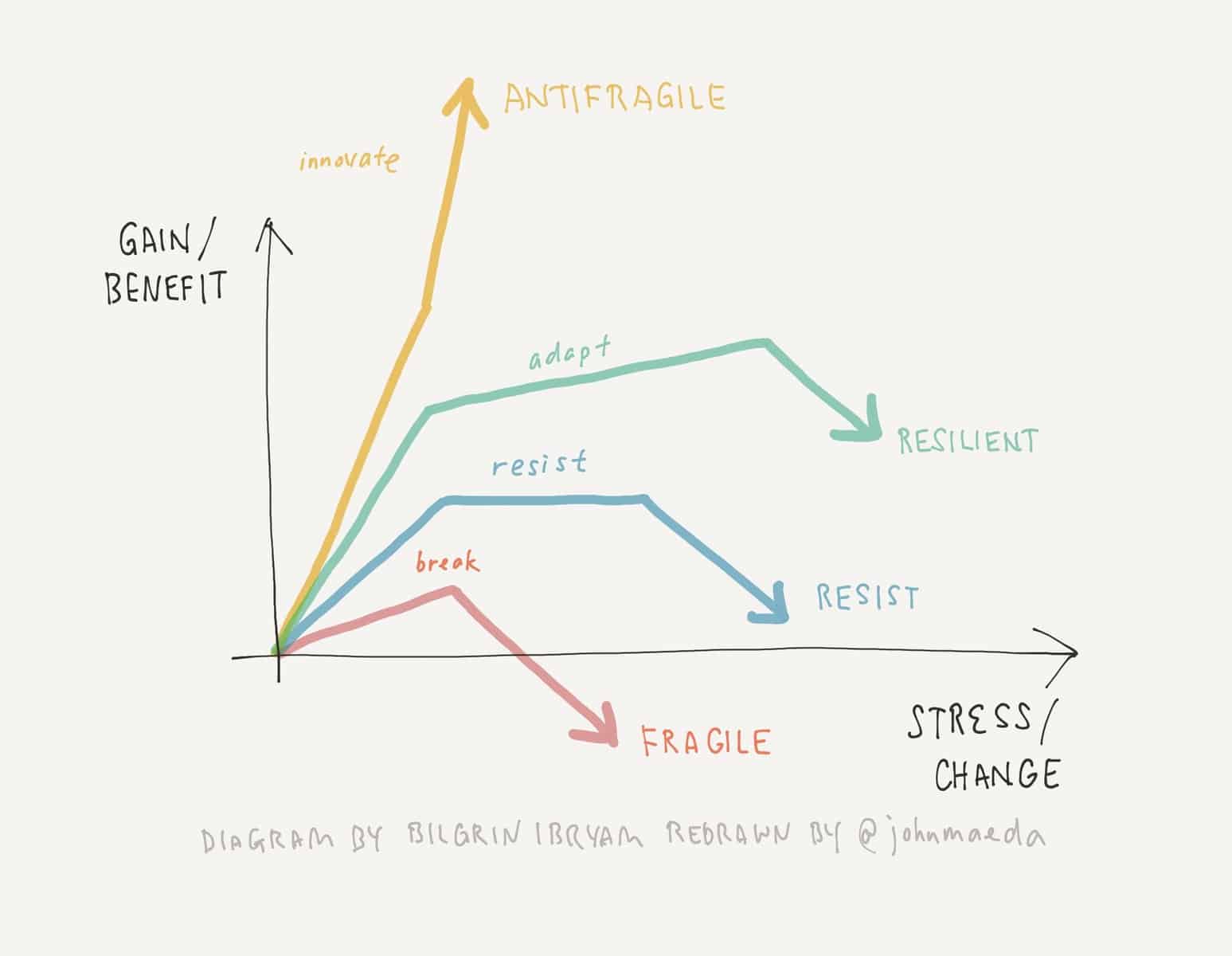
  • Building an “anti-fragile” life. Instead of a rigid architecture that may suffer when the next storm will hit (and it will), a flexible backbone for your personal life will help pivoting if necessary. For example, avoiding leverage heavily on non-liquid assets or teaching your kids languages so they could eventually start a new life anywhere.
  • Personal development. Relevant knowledge fields are endless, and very accessible. For example, I want to be self-sufficient when conceptualizing new digital products and services so I’m considering training myself on “no code” software development.
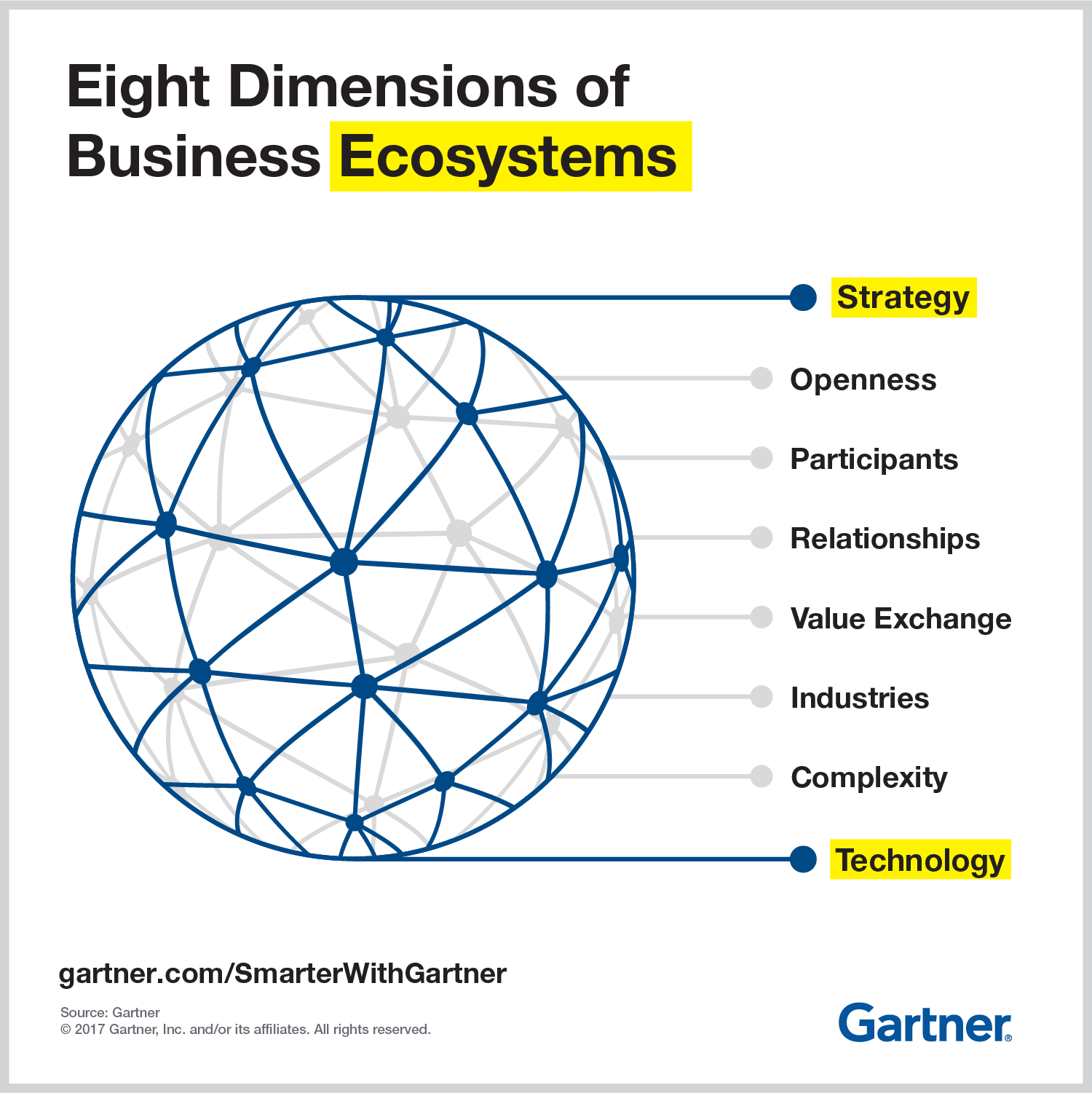
  • Ecosystems. I’m convinced about the fundamental power of networks and ecosystems in every aspect of life in the years to come. Competitors will suddenly become co-opetitors, industries will merge to deliver new unique value propositions. The definition of what a country or a company or any other institution as aggregators of human volition will be blurred. Associations between individuals will be much more related to achieving a certain goal.
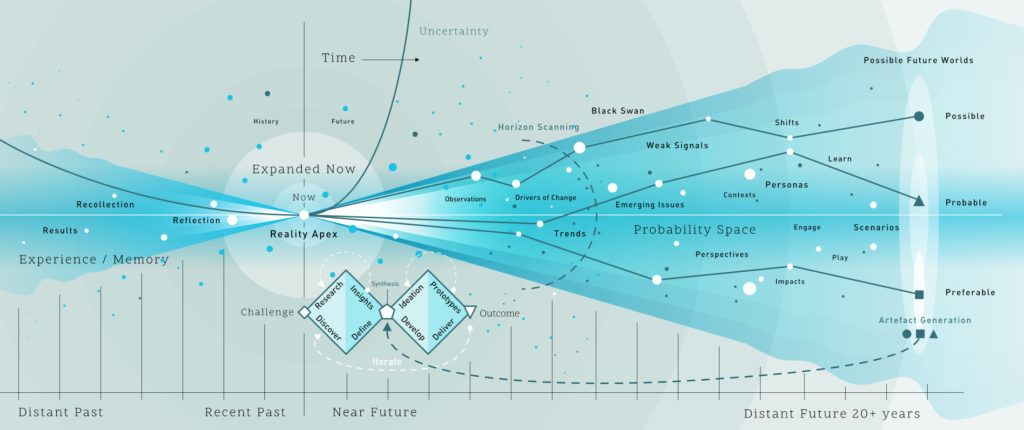
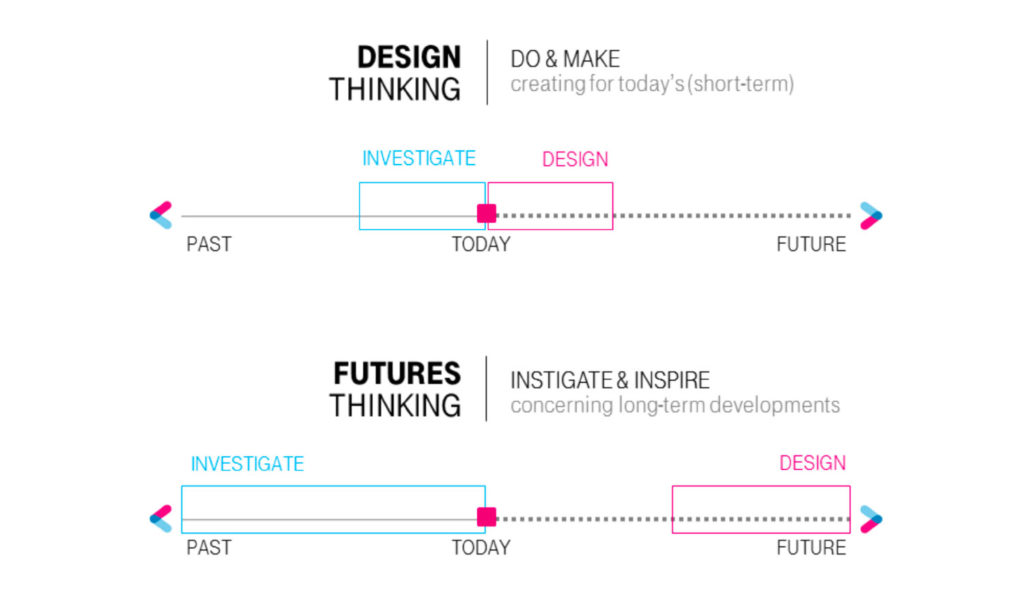
  • Working on the variables under control and explore scenarios. As an engineer, I never forget that for controlling a complex system, your focus must be on input variables under your control. All the others should be understood and observed, but if there is not much you can do about them, they shouldn’t occupy much mental bandwidth. At the same time, spending some time on “futures thinking” can help you understand potential outcomes of current course of action. The future will never be as you imagined, but preparing for several future situations will very much help you to act rapidly as circumstances will change.

Life is too important to adopt an attitude of “wait and see”. We normally have more levers to press than we think, and it is by far so much interesting. Let’s recover the control of our “aircraft”. Let’s do it, and let’s do it now.

Food for thought:

Tu Eurocopa y la mia, han sido diferentes

Julio ha llegado (y casi ha pasado), con la deseada Eurocopa, y los juegos olímpicos a puntito de empezar. Estos son dos de los eventos con mayor audiencia del planeta. Todos los países de mundo (o de una region en el caso de la Eurocopa) , en frente de un televisor (veamos que datos nos ofrecen las audiencias en cuanto a uso de ordenadores, tables y smartphones) viendo competir a los equipos de sus países.

Estos eventos no solo son deseados por los aficionados, sino también por anunciantes de todo el mundo. La repercusión e impacto mediática es enorme, y pocas veces se puede conseguir de una sola vez un impacto de este volumen (imagina la final de 100, la final de la Eurocopa, ceremonia de inauguración,..).

Todos tenemos en mente que estos espacios publicitarios están reservados a grandes marcas multinacionales, con mucho presupuesto, que tenga presencial en muchos países, o que estén buscando mucha notoriedad (posiblemente por una expansion inmediata o futura). Sin embargo en esta Eurocopa, hemos visto un gran cambio, que ya había sido probado con anterioridad en algún otro evento deportivo. Este cambio supone una gran revolución en muchas dimensiones. Este cambio consiste en la personalización de los anuncios del estadio, en función del país de emisión (Virtual ads). Vamos que quién viera el partido desde Inglaterra, Francia o Alemania, estaba viendo diferentes anuncios dentro del mismo partido, pero relevantes para su geografía.

Se trata de nueva tecnología, donde la cámara está conectada un controlados, que monta las imágenes y las distribuye a las cadenas con los anuncios relevantes para esa región.

Podríamos escribir lineas y lineas sobre la tecnología en concreto, pero en esta ocasión me gustaría centrarme mas en las oportunidades y retos que se abren.

Oportunidades

El tan denostada concepto de la ¨democratización de¨ (la publicidad en este caso) se hace patente. El impacto en cuanto a numero de visualizaciones bajará, al verse reducido el alcance de la emisión por la geografía, lo que posiblemente hará bajar los precios. Con eso muchas mas marcas tendrán acceso a estos espacios publicitarios, que tan interesantes son.

Según veamos que va avanzando la tecnología, podremos ver personalización no solo en las vayas de los estadios, pero en muchos mas lugares. Se podría incluso llegar a personalizar pequeños detalles (dorsales de los atletas?) o ciertos elementos de películas.

A día de hoy se habla de una personalización regional, pero con la cantidad de datos personales que existen nuestros, se podría bajar a un detalle mucho menos, por ciudades, barrios, o a nivel personal.

Las marcas que cuenten con una estrategia de marca correcta, que esté alineada con los valores del deporte, del equipo o deportista en cuestión, podría conseguir un impacto y engagement mayor con sus seguidores

Retos

Sin embargo, estén varias campos que exportar. Esta personalización, sobre todo cuando hablemos a escala, requerirá de mayor ancho de banda, y la cobertura 5G tendrá un papel fundamental.

Por otro lado está el cumplimiento de la reglas de privacidad. A día de hoy se controla con los permisos que como usuarios damos por email, y otros canales a contactar con nosotros. ¿Que pasarán cuando la tele se convierta en un canal con personalización? Tendremos que añadirlo a nuestro centro de preferencias y capturar el permiso del usuario

¿Cúal va a ser el límite de esta personalización? Si hablamos de personalización de las vallas de los partidos de futbol en función de la región, en principio todos estaremos viendo el mismo partido, con un pequeño toque local. Pero en en momento que más elementos se configuren para nosotros, estaremos teniendo experiencias totalmente diferentes que pueden impactar en nuestra percepción. ¿Podremos seguir comentando la jugada del partido o cierta escena de televisión con amigos y familiares, o cada uno tendremos una perspectiva muy diferente?

A día de hoy todos los marketeros (del espacio más digital) sufren para tener una medición real de todos los canales con los que trabajan de forma consolida, actualizada y realista. ¿Cómo conseguiremos tener ciertas métricas del rendimiento y efectividad de estos anuncios personalizados por televisión?

Esta claro que el medio audiovisual está en plena transformación. La llegada de Netflix, Amazon primer, HBO no ha hecho nada más que destapar oportunidades y retos. Las cadenas de televisión y productores buscan como transformar sus organización y el producto que ofrecen. Lejos queda los tiempos de la tele en blanco y negro con dos canales sólo. Además los usuarios cada vez consumen más plataforma, y menos programación. Todos estos elementos están moldeando el futuro de la industria, que es además en sí un canal que todos o casi todos los sectores usan. Atentos porque esto no hecho mas que empezar.

Charlamos con Gonzalo Mestre, CEO y fundador de Sheedo

Esta semana charlamos con Gonzalo Mestre, CEO y fundador de Sheedo, quien con nos contara el papel tan relevante que tiene la innovacion y el marketing en su empresa, y como han conseguido cambiar las reglas del juego en sectores tan tradicionales como la industria papelera.

Link a la charla. Y también puedes escucharlo en nuestro nuevo podcast de Spotify

¿Ha deshumanizado las relaciones el corona virus?

Más de un año llevamos metidos en esta locura de pandemia que tantos hábitos ha modificado. Nadie pensaba que trabajaríamos, haríamos deporte, celebraríamos con la familia y asistiríamos a convenciones desde el salon de nuestra casa. Una vida completamente virtual donde Zoom, Google Hangout, Teams y otras herramientas de comunicación han sido ampliamente usadas. Saldremos de esta pandemia, por supuesto, y espero que todos hayamos aprendido algo. La forma de trabajar y comunicarnos ha cambiado sin duda. Hemos visto que el tele-trabajo es posible, hemos visto que una vida sin tanto viaje es posible, la gran pregunta es si es deseable.

A nivel de comunicación de marcas, los canales digitales ya habían virado hace tiempo en esta dirección. La comunicación digital se impuso, antes del maldito virus, como medio preferido de comunicación, por diferentes motivos. Por lo que estábamos acostumbrados a interactuar con muchas marcas y organizaciones de forma digital solo. Sin embargo, con muchas de ellas lo seguíamos haciendo de forma presencial. La primera de todas con nuestra empresa, a la que acudíamos diariamente a trabajar presencialmente y relacionarnos con nuestros compañeros. Por otro lado los congresos, conferencias y convenciones, donde intercambiamos opiniones y experiencias con personas de otras organizaciones en un ambiente diferente, y en un lugar parecido se encuentra la educación, ya que el modelo online (en algunos casos híbrido) empieza a coger tanta fuerza.

Muchos son los estudios que apuntan a una lenta recuperación del sector turístico (especialmente por el lado de viajes profesionales y de negocios), debido a la irrupción de este mundo virtual (por efecto de la pandemia). Por supuesto que esto tiene mucho impacto colaterales importantes, como puestos de trabajo, perdida de PIB en ciertos países, reducción importante de facturación para muchas empresas (aerolíneas, ciertos hoteles,..). La reconstrucción de estos sectores será fundamental para la recuperación. Sin embargo, hay que pensarlo desde otro de vista, ¿qué más cosas estamos perdiendo?

El gran beneficio de la tecnología es que está disponible para todos, y su uso puede beneficiar a muchos (empresas y usuarios). El problema es cuando intentamos utilizar la tecnología con el objetivo de implementar un canal digital que sustituya lo que teníamos antes. Los canales digitales tienen muchas ventajas, pero no se pueden comparar, en ciertos aspectos, con los presenciales. Todos hemos experimentado tomar una cerveza por videollamada con nuestros amigos durante la cuarentena. Efectivamente, servía, nos veíamos las caras, pero no es comparable con estar sentado en una terraza, donde la experiencia es completamente diferente. Sin embargo, nos ha servido también para retomar relaciones con gente con la que de forma presencial no podíamos interactuar, porque vivieran en otros países, u otras circunstancias. Tomémos el ejemplo de la educación, con el cambio en los programas de educación ejecutiva online de muchas grandes escuelas, actualmente podemos hacer cursos en escuelas de todo el mundo. Por lo tanto, todo tiene sus ventajas.

La pregunta que hacía antes es, ¿qué estamos perdiendo?. Creo que sin una ejecución excelente de este tipo de proyectos de digitalización podemos tener el riesgo de perder la humanización que muchos de estos eventos tenían. como hemos visto la tecnología nos ayuda a avanzar y nos aporta grandes beneficios, pero tenemos que velar por no perder esa seña de identidad que tiene el ser humano: el contacto social. El ser humano es una animal social, y busca la relación con sus similares. La tecnología ayuda enormemente, sin embargo, muchas organizaciones han caído en pensar en una traducción directa y sin pensar en la persona. Soy alumno de varias universidades online, en la que he realizado diferentes programas. Creo que es una experiencia muy buena, pero muy diferente de la universidad típica y tradicional a la que estamos acostumbrados. No tenemos una secretaría a la que dirigirnos si tenemos un problema, o no podemos girarnos y preguntar a un compañero o levantar la mano si no entendemos algo. Muchas de estas instituciones tienen que tener en cuenta la madurez digital de sus alumnos y aportar mecanismos que ayuden en ese proceso de aprendizaje. La tecnología puede incluso para predecir cuando un alumno pueda tener problemas en función a sus interacción con el campus virtual (en esos casos el profeso o tutor no puede mirar a la cara para intentar descifrar sus sentimientos). Todas estas actividades que manejamos por canales digitales, tienen que tener un objetivo humano y social, diseñemos los sistemas en base a esto. De forma similar podemos hablar de eventos corporativos o conferencias, donde la interacción con los individuales es más compleja. Muchos de estos eventos servían para relacionarnos con profesionales de otras instituciones o de otros equipos. ¿Cómo podemos hacer para no perder ese aspecto social y humano, y no centrarnos simplemente en la dimensión de compartir conocimiento y realizar ponencias?

En el caso de las marcas de gran consumo, debemos evitar en caer en algo parecido. Esta claro que en el mundo del gran consumo es complicado captar ese elemento social con los diferentes consumidores. Hace algunas semanas hablamos que la automatización está matando la creatividad , y este punto es fundamental. Debemos considerar la importancia del dato en este punto también, ya que nos servirá para conocer mejor al individual con el que interactuámos, qué es lo que necesita y cómo podemos ofrecérselo. Por supuesto, no olvidando que la creatividad nos dará ese componente social, que muchas veces falta al automatizar estas acciones comerciales. Las marcas tienen que estar cada vez más cerca de sus clientes, ya sea mediante un mejor conocimiento de los mismos, ofreciendo una mejor personalización y experiencia de cliente, que coincida con la expectativas.

Soy positivo, y creo que hemos aprendido mucho de estos meses tan duros. Espero que todo esto que hemos aprendido, no se haya al mismo ritmo que nos quitamos las mascarillas y nos olvidamos del significado de PCR. El mundo ha marcado un rumbo hacia el entorno virtual que nos aportar muchas ventajas, y la innovación vendrá marcada por como embeber componentes sociales y humanos en estas areas para conseguir que el ser humano siga siendo un ser social. La creatividad, el pensamiento crítico, lateral y divergente (donde los equipos multidisciplinares y diversos son clave )será herramientas fundamentales que nos ayudarán en el desarrollo y avance en la dirección correcta.

¿Evolución o innovación?

Creo firmemente en la necesidad de la educación continua a lo largo de nuestras carreras profesionales. Aunque esto sea más válido que nunca, parece que muchos de los eventos que estamos viviendo están poniendo esta necesidad en las agendas de muchos ejecutivos. Y no me refiero solo a los efectos de la pandemia, sino también a la llegada de nuevos jugadores modificando modelos de negocio y las reglas establecidas, o incluso a nuevas necesidades de clientes que hasta ahora no estaban cubiertas. Todo esto hace que las organizaciones, aquellas que quieran no solo sobresalir sino también sobrevivir, tienen que reinventarse. Recordemos que una organización es el conjunto de todos las personas que la forman, por lo que pensemos en las personas para ver cómo juntos podemos llegar al punto que queremos.

Muchas de las grandes consultoras han creado modelos de madurez digital, incluso centrándose en ciertos areas en concreto (marketing, ventas, tecnología,..). Por citar algunos ejemplos tenemos a IDC, Gartner, Deloitte, Forrester or BCG. Incluso yo también me he lanzado a crear mi propio modelo, que se ajuste mas a las organizaciones con las que trabajo en cuanto a procesos, capacidades, sistemas específicos o ajustando el lenguaje. No creo que haya inventado la pólvora ni mucho menos, pero creo que este ejercicio es al que tienen que enfrentarse las organizaciones por un lado y los individuales por el otro. No solo hacer esta autoevaluación siguiendo un modelo ya creado, sino pensar que es relevante para mí y ajustar el mismo. Esto hará que tengamos en cuenta esas particularidades que son las que nos hará sobresalir. La comparación con un modelo nos hace descubrir dónde tenemos areas de mejora, o qué aspectos son sólidos y debemos seguir apostando por ellos.

Todos estos modelos tienen una estructura común, se establecen varios estados, en los que se indican los factores para decidir en cúal de esos estados te encuentras. El paso de un estado a otro (de izquierda a derecha) indica mayor madurez, y mayor adecuación a los que se está pidiendo en cuanto a tendencias y análisis de diferentes datos disponibles. En los modelos mas complejo se indican otras variables que pueden ayudar a entender esfuerzo/impacto.

Estos ejercicios creo que son muy valiosos, tanto a nivel organizacional como individual, ya que sirven de brújula y para recalibrar hacia dónde debemos movernos. Independientemente de cúal sean esos estados, los pasos o los factores a tener en cuenta, creo que hay varios conceptos que son comunes en todos y que sirven como reflexión para ver si los tenemos en cuenta actualmente.

Las organizaciones están en cambio constante, y no podemos esperar que esto suceda si nuestro rol no cambia. Hemos oído muchas veces eso de salir de nuestra zona de comfort y este es uno de esos ejemplos. Cuando llevamos tiempo en una posición conocemos lo que implica y cómo se trabaja, y nos acomodamos a una rutina. Pero debemos mirar qué impacto está teniendo nuestro trabajo en la organización para poder evolucionar o innovar lo que hacemos. Por ejemplo, en el área de marketing se evolucionó desde una perspectiva de comunicación y publicidad, a algo más integral que tuviera en cuenta la generación de negocio (generación de leads..). Sin embargo, el paso adicional que se requiere es ver el resultado en esa generación de negocio y la aportación que se realiza. El responsable de marketing debe tomar un rol mucho más estratégico, que abarque mucho mas que la promoción de productos o la marca. Se ha hablado mucho de las estrategias de ¨Growth management¨. Esto implica un conocimiento mayor de la organización, del modelo de negocio, de la estrategia corporativa (y no solo comercial). Esto hará que el marketing sea el motor de crecimiento de la empresa. Y ese crecimiento puede ver dado por expansión en nuevos territorios o extensión de nuestra huella en clientes existentes.

Ese paso tendrá implicaciones en muchos individuales y los equipos en los que estos trabajen. Por ejemplo, la forma en la que se establecen los objetivos tiene que ser mucho más alineada, de forma que el trabajo realizado por la organización se amplifique al trabajar todos los equipos en la misma dirección (ejemplo OKRs o V2MoM) . Por otro lado, y como parte de esos objetivos, sera necesario hacer una evaluación de qué competencias adicionales son necesaria para poder innovar y desarrollar estas nuevas responsabilidades. En muchos casos se habla de competencias digitales, pero no debemos olvidar el pensamiento crítico, resolución de problemas complejos, inteligencia emocional, empatía u otros llamados ¨soft skills¨.

Hasta ahora hemos estado acostumbrados a trabajar en equipos organizados de forma jerárquica bajo una organigrama. Vemos que la capacidad de realizar el trabajo cada vez más reside no en los galones que tengamos, sino en lo que seamos capaces de movilizar a los equipos, de inspirar y convencer. Para esos las redes de contactos personales, dentro y fuera de nuestros equipo, dentro y fuera de nuestra organización, son fundamentales. Las organizaciones empiezan a ser conjunto de equipos inter-conectados, que cuantas mas conexiones tengan más rápido y con más eficiencia serán capaces de moverse. ¿Estamos operando así en nuestro puesto actual? ¿Y nuestro equipo, qué conexiones tiene fuera de nuestro organigrama?

Trabajar de forma más extensa (utilizando nuestro networking), bajo un entendimiento más profundo de nuestro negocio, nos hace también depender de datos. Tomar decisiones basadas en datos, es otro de esos puntos a mejorar. Para ello debemos evitar que nuestras decisiones estén sesgadas o enfocadas en puntos concretos, sino teniendo esa visión completa. La organización debe tener la capacidad (y tecnología) para poder analizar esos datos de forma conjunta, y nosotros debemos estar capacitados para entender y tomar acciones basados en estos.

Aunque seguro que hay muchos mas puntos que podemos señalar y analizar ( animo a aportar en los comentarios o cualquier otro medio para poder seguir aprendiendo en esta comunidad). Estos modelos nos ayudan a reflexionar pero lo más importante es establecer un plan de acción. Al igual que lo comentado en el párrafo anterior, los datos no son útiles al ser analizados, sino al actuar sobre ellos. Lo mismo pasa con estos modelos de madurez, establecer un plan de acción que nos ayude a movernos en la dirección deseada será lo que haga que funcionen como la brújula que buscamos. Nuestra capacidad de innovación vendrá marcada por los riesgos que queramos buscar en cuanto a las nuevas capacidades que queramos adoptar.

Ladrillos y cemento

Trabajar en remoto, comprar online, cine y teatro en casa, visitar ciudades a través de una pantalla, eventos virtuales, cenas y copas por el ordenador..Todo esto nos parecería imposible hace poco mas un año, y sin embargo, aquí estamos. Los patrones de comportamiento han cambiado, y no solo en el consumidor, pero también en el empleado. Con motivo de este pequeño y tan molesto virus, muchos de estos procesos que se están viendo en años anteriores, se han acelerado a nivel global.

Obviamente nos encontramos en una situación de incertidumbre, y todavía en modo pandemia. Pero todas las empresas y organizaciones se han empezado a plantear que va a pasar, cuando esta fase aguda se acabe. Y digo aguda, porque esto se convertirá en algo crónico. Todos hemos descubierto las ventajas e inconvenientes que estos cambios nos han originado, todos tenemos nuestras preferencias. Ahora nos encontramos en un extremo donde todo es virtual, venimos del extremo contrario donde todo (o casi todo) era presencial, por lo que terminaremos en un termino medio. La pregunta es cuándo, y en formato quedará todo.

Cada industria es diferente y esta siendo afectada de forma diferente. Por supuesto el sector turismo puede acogerse al mundo virtual como solución temporal, o complementaria, pero cuando nos vamos de vacaciones, queremos hacerlo fuera de la pantalla y disfrutar de forma real. Sin embargo otros sectores están todavía en pleno ajuste. Hay muchos ejemplos, pero en este caso me centraré en dos, que creo que todos vamos a utilizar, de una manera u otra.

A nivel general el mundo inmobiliario (real state según la voz anglosajona) está siendo impactado de pleno. Con todas las restricciones y las posibilidades de trabajo en remoto, muchos ciudadanos se han planteado su estilo de vida, y están migrando (o considerándolo seriamente) afuera de grandes ciudades, ya sea campo o playa. Fue noticia durante semanas la cantidad de madrileños que fueron a pasar el encierro del 2020 a sus casas de la playa en el sur de España. Pero también hay varios informes que hablan del cambio de preferencia en el estilo de residencia que queremos, cambiando también el diseño de las mismas. Todos hemos tenido que reconvertir salones, cocinas o habitaciones en despachos, y reorganizar la casa para acomodar todas estas actividades online, que antes se llevaban acabo fuera del hogar. Podemos ver un impacto también en las residencias de estudiantes, ya que si los programas universitarios son online, no es necesario que los estudiantes residan en esa misma población. Y por supuesto uno de los grandes impactos vendrá dado por los cambios en los espacios de trabajo, las oficinas.

Todos hemos oido la historia de WeWork, la ¨startup¨ que revolucionó la forma de ofrecer sitios de trabajo, pensando en profesionales autónomos, o pequeñas organizaciones. Obviamente este historia tiene mucho mas por detrás, como su salida a bolsa, la financiación de softbank, el cambio de CEO. Sin embargo creo que este modelo ha llegado para quedarse. Cualquier empresa se ha dado cuenta que el trabajo en remoto funciona, y todos lo hemos hecho. Las cosas han salido adelante y siguen haciéndolo. Es cierto que en ciertos momentos se hecha en falta la presencia física, ya sea para una reunión puntual, o para un cafe informal donde podamos ampliar nuestra red de contactos, hablar con otros compañeros y seguir trabajando esa cultura de empresa. Todo esto, que ahora es más difícil (que no imposible), nos llevará a esa modelo mixto de trabajo. Muchas organizaciones se están planteando la vuelta a las oficinas, no solo desde el punto de vista legal o logístico, sino también conceptual. Entender que uso haremos del espacio físico de estas oficinas nos podrá hacer rediseñarlas acorde a ese uso. Netflix, Spotify o Facebook ya han anunciado su intención de permitir flexibilidad para que el trabajador trabaje desde donde desee. Salesforce ha ido más allá incluso considerando una nueva re-distribucción del espacio físico de sus oficinas, donde las salas de reunión, los espacio de colaboración y para socializar cobrarán un mayor peso.

Está claro que se esperar muchos cambios al respecto. Muchas organizaciones del sector, o de fuera están haciendo sus predicciones (Forbes, New Yorker, The Spaces, Cushman&wakefield). Se habla de incluso no solo de un rediseño de los espacios para centrarse en la colaboración, dejando el trabajo individual para casa. Pero incluso se llega a plantear que las organizaciones cuenten con pequeñas oficinas repartidas por la ciudad para que cada empleado las utilice en función de su conveniencia. Esto reduciría las grandes oficinas, en cuanto a metros cuadrados, dando origen a mas localizaciones. El impacto de los precios estaría por ver, ya que algunas organizaciones pueden optar por pequeños locales emblemáticos en el centro de la ciudad, y otros en las afueras donde residan sus empleados. Esto tendrá una repercusión en los locales de restauración que se han creado históricamente alrededor de esos centros de trabajo, al igual que otros negocios asociados como guarderías, tintorerías, ..

Por otro lado, como consumidores, todos estamos utilizando la compra online para todo tipo de productos. El e-commerce está en una tendencia claramente alcista, no solo por su estado de madurez natural, sino también por covid19 que ha servido como catalizador. No solo muchas empresas y marcas han lanzado tiendas online que antes no existían, sino que aquellas que ya utilizábamos han crecido. Y con esto, algo que no vemos y que trabaja en la sombra es la logística asociada. Almacenes, transporte, preparación de pedidos. Se trata de un negocio que está expuesto a muchos cambios, donde la eficiencia y los costes juegan un papel fundamental para ser competitivos. Es interesante ver la aparición de los llamados ¨dark stores¨. Muchas de las organizaciones que operan online se han dado cuenta de la importancia de esta parte que queda fuera de la web o nuestro e-commerce, pero que será una de las grandes piezas de nuestra experiencia de cliente. Es importante no solo servir el pedido en condiciones, sino en el tiempo acordado. Las expectativas con Amazon prime están muy altas, y esto puede hacer perder oportunidades. Pro eso motivo, muchas de los locales existentes se han reconvertido en almacenes y ligares de preparación de pedidos. Si los números de ventas online crecen, este tipo de logística debe estar acorde. Tener centros de distribución y preparación de pedidos cerca del cliente final nos hará ganar ese tiempo que necesitamos para que la experiencia de cliente, y el tiempo de entrega sea el prometido. Esta es una tendencia en empresas de alimentación, cuyos productos tienen limitaciones en cuanto a tiempo y condiciones de almacenaje, pero otros sectores están apostando por esta estrategia. Se trata de optimizar los espacios físicos disponibles para estar a la altura de las necesidades actuales.

Los espacios físicos, ya sean en nuestra vida personal o profesional están cambiando. Pensar ¨out-of-the-box¨, para poder innovar y traer soluciones a las necesidades actuales será un ejercicio que todas las areas de la compañía debe hacer en consenso, debido al impacto financiero, en la imagen de marca, numero de ventas o atención al cliente. Virtual, presencial o híbrido, el debate está servido.

Charlamos con Luis Martin, Director de Deep Digital Business de LLYC.

Esta semana hemos tenido el placer de charlar con Luis Martin, director de la nueva unidad de Deep Digital Business de LLYC (Llorente y Cuenca). Enfocamos la charla alrededor de » La Voz», no solo como herramienta principal en el Storytelling, pero como interfaz con la tecnologia. Muchos retos y oportunidades por decubrir.

Link a la entrevista (Link)