
The «Lindy Effect» or how to predict the next big thing

When working in Innovation, a common question you frequently ask yourself is what trends will stay and which ones will slowly fade away. That way you can assess whether investing in something is worth or you should think on the next big thing.

This question also applies for example to you personal investing decision: should I buy a flat in that city so I can expect renting fees to raise as it becomes more popular? should I buy Bitcoins as more people will be willing to buy them next year?

A mental model that I like very much that I discovered when reading “Antifragile” from Nassim Thaleb is “The Lindy Effect”. According to that model, the way to better predict if some trend will stay is looking for how long it has been around. For example, if “Let it be” from The Beatles has been a great success for many generations, chances are high that it will continue to stay with us for many more years to come, while the latest hit from Dua Lipa could eventually be lost in our memory the very next year.

That doesn’t mean that new things are never successful. The truth is that progress replaces technologies from the past as new more effective and efficient solutions are put in place. Think for example about Hyperloop (the ultra-high-speed ground transportation system for passenger and cargo proposed as a concept by Elon Musk, CEO of Tesla and SpaceX). Chances are high that it will sooner than later become a winner way of transportation, but if you think about the fundamental concept behind it is that it is a train. Not a regular train but a very sophisticated one, but fundamentally it is a train. And trains have been around us since Richard Trevithick invented it in Cornwall in 1804.

No alt text provided for this image

I would love to read your thoughts on how you manage your “crystal ball” when traying to identify emerging trends. Do you believe in the “Lindy Effect”?

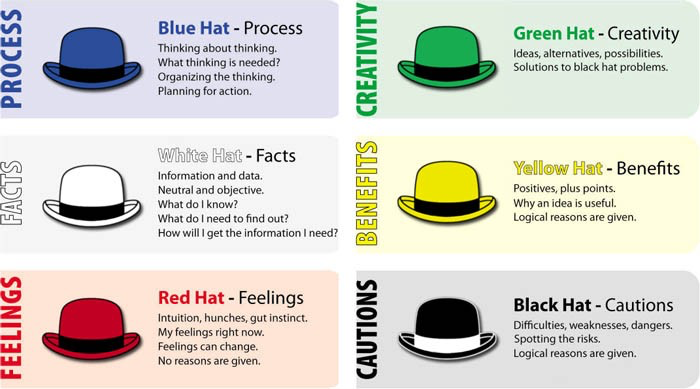
Six Thinking Hats for better decision making

Human mind is amazing. Our cognitive skills are out of this world, but we have an issue. Whenever we try to assess a challenge or an opportunity, quite frequently we get in love with our initial thought about it and “anchor” ourselves to this initial idea that came to our mind when we started discussing the topic.

Edward de Bono, the father of “lateral thinking”, created a framework to systematically analyze opportunities and challenges with a structured process to ensure that we take into consideration every perspective. It was called “Six Thinking Hats”.

The premise of the method is to challenge our way of thinking sequentially, to bring into conscious thought every aspect of the topic under discussion.

Blue hat – The “big picture”

White hat – Information and hard facts

Red hat – The feelings and emotions

Black hat – The negative perspective

Yellow hat – The positive perspective

Green hat – The world of the new ideas

The key to a successful Six Thinking Hats session is focusing the discussion on a particular mental mode (symbolized by the color of the hat) at any time. The order when using the different hats depends on the nature of the discussion. A quite effective one could be the one that would lead to exploring the challenge, developing several potential solutions and agreeing on a decision.

Blue (understand the topic) –> Red (capture feeling and emotions) –> Green (explore potential solutions) –> White (discuss hard facts and assumptions) –> Yellow (capture pros) –> Black (capture cons).

The beauty of this method is that because everyone is focused on a mental mood at any one time, the group tends to be more collaborative.

Have you tried this technique when discussing a new opportunity or challenge? What was your experience? I have been practicing it during the summer break with great success and I’m planning to do it more frequently in the months to come. By the way, if you have kids it works fantastic with them.

#EdwardDeBono ; #LateralThinking ; #SixThinkingHats ; #Innovation ; #DecisionMaking ; #MentalModels ; #CognitiveSkills